Egyptian Artwith the Exception of the Amarna Periodcan Be Described as Which of the Following?
Architecture of the New Kingdom
The gilt age of the New Kingdom created huge prosperity for Egypt and allowed for the proliferation of monumental compages.
Learning Objectives
Explain why the New Kingdom is considered the aureate age of Ancient Egyptian art
Cardinal Takeaways
Key Points
- Luxor Temple is a large temple circuitous located in what was ancient Thebes and is known for its use of symbolism and illusionism.
- The Temples at Karnak, role of the great urban center of Thebes, were constructed as an ancient place of worship for the god Amun. They consist of a vast mix of temples, chapels, pylons , obelisks , and hypostyle halls decorated with elaborate friezes .
- The Temples of Karnak consists of 4 main parts: the Precinct of Amun-Re, the Precinct of Mut, the Precinct of Montu, and the Temple of Amenhotep Four.
- Although pyramids were no longer built at this fourth dimension, magnificent tombs were constructed for the pharaohs and powerful nobles of the New Kingdom in the Valley of the Kings over a period of most 500 years.
- Amongst the well-nigh famous tombs in the Valley of the Kings are the tombs of Tutankhamun, Hatshepsut, Ramesses, and Nerfertiti.
Key Terms
- pylon:A gateway to the inner part of an Ancient Egyptian temple.
- hypostyle hall:A structure in which a roof is supported by columns.
- frieze:Any sculptured or richly ornamented band in a building or, by extension, in rich pieces of article of furniture.
The New Kingdom is known as the golden historic period of ancient Egyptian history and is the period of Hatshepsut, Tutankhamun, Ramses Ii, and other famous pharaohs. The wealth gained through military authority created huge prosperity for Egypt and allowed for the proliferation of monumental architecture, particularly works that glorified the pharaohs' achievements. Starting with Hatshepsut, buildings were of a grander scale than anything previously seen in the Middle Kingdom .
Luxor Temple
Luxor Temple is a large temple complex located on the east banking concern of the Nile River in what was ancient Thebes (today the metropolis of Luxor). There are six keen temples: four on the left banking company known as Goornah, Deir-el-Bahri, the Ramesseum, and Medinet Habu; and 2 on the right bank known as the Karnak and Luxor. The Luxor temple was built with Nubian sandstone from south-western Egypt. Similar other Egyptian structures, common techniques were the apply of symbolism and illusionism. For case, a sanctuary shaped like an Anubis Jackal was used as a representational symbol of Anubis. To emphasize pinnacle and altitude and enhance an existing pathway, two obelisks flanking the entrance were built with the illusion that they were the same height—even though they weren't.
Temples at Karnak
This complex is comprised of a vast mix of decayed temples, chapels, pylons, and other buildings. An ancient place of worship for the god Amun, it was function of the monumental city of Thebes. Today, the circuitous is a vast open-air museum and the largest ancient religious site in the world. The circuitous consists of four main parts: the Precinct of Amun-Re, the Precinct of Mut, the Precinct of Montu, and the Temple of Amenhotep 4.
The Precinct of Amun-Re, also referred to every bit the Temple of Amun, is the largest of the temples and the only one open up to the public today. The columns of its Hypostyle Hall imitate lotus plants and contain elaborate sunken relief .

A panorama of the great hypostyle hall at Karnak: The Precinct of Amun-Re is part of the cracking temple circuitous at Karnak.
Nigh every pharaoh of that dynasty has added something to the temple site. It features large sandstone columns, several colossal statues, and ane of the largest obelisks, weighing 328 tons and continuing 29 meters tall. Many of the walls were decorated with richly ornamented friezes.

A panorama of a frieze in the Precinct of Amun-Re: Great monuments and temples were frequently decorated with elaborate relief sculpture during the New Kingdom.
Located to the south of the newer Amen-Re circuitous, the Precinct of Mut was defended to the mother goddess Mut. Hapshepsut helped to restore the original precinct, which had been ravaged during the Hyksos occupation, and had twin obelisks erected at the archway to the temple; ane still stands every bit the tallest surviving ancient obelisk in the world. The precinct has several smaller temples associated with it and has its own sacred lake, constructed in a crescent shape. Six hundred blackness granite statues were found in the courtyard to her temple, possibly the oldest portion of the site.
The smaller Precinct of Montu is dedicated to the state of war-god of the Theban Triad, Montu, and is located to the northward of the Amun-Re complex.
The Temple of Amenhotep IV was located east of the main complex and was destroyed immediately after the decease of its builder, so its total extent and layout is currently unknown.
The Valley of the Kings
Past this time, pyramids were no longer congenital by kings, merely they continued to build magnificent tombs. This renowned valley in Arab republic of egypt is where, for a period of nearly 500 years, tombs were constructed for the Pharaohs and powerful nobles of the New Kingdom. The valley is known to contain 63 tombs and chambers, the about well known of which is the tomb of Tutankhamun (commonly known as Rex Tut). Despite its small size, it is the most consummate aboriginal Egyptian imperial tomb ever plant. In 1979, the Valley became a Globe Heritage Site, forth with the rest of the Theban Necropolis .
Hatshepsut
The Temple of Hatshepsut was Hatshepsut'south mortuary temple and was the first to be built in the area. The focal betoken of the tomb was the Djeser-Djeseru, a colonnaded construction of perfect harmony that predates the Parthenon by nearly one thou years. Built into a cliff face, Djeser-Djeseru, or "the Sublime of Sublimes," sits atop a series of terraces that once were graced with lush gardens. Funerary goods belonging to Hatshepsut include a lioness "throne," a game board with carved lioness head, red-jasper game pieces bearing her title every bit pharaoh, a signet band, and a partial shabti figurine bearing her name.
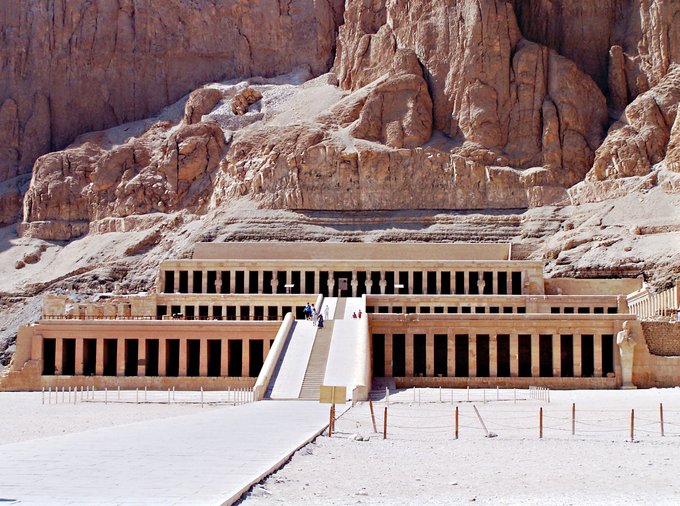
Colonnaded design of Hatshepsut temple: Hatshepsut's temple is most famous for its Djeser-Djeseru, a colonnaded structure of such architectural skill that predates the Parthenon by about one one thousand years.
Tutankhamun
Tutankhamun was an Egyptian pharaoh of the Eighteenth Dynasty, who ruled from around 1332 BC to 1323 BCE. Popularly referred to as "King Tut," the boy-king took the throne when he was nine and ruled until his early on decease at historic period nineteen. Tutankhamun was buried in a tomb that was pocket-sized relative to his status. His death may have occurred unexpectedly, before the completion of a grander imperial tomb, and then that his mummy was buried in a tomb intended for someone else. His mummy still rests in his tomb in the Valley of the Kings, though is at present on display in a climate-controlled glass box rather than his original gold sarcophagus . Relics and artifacts from his tomb, including his pectoral jewels and a carmine granite panthera leo, are among the near traveled artifacts in the world.

Painted walls in the burial chamber of Tutankhamun's tomb, Valley of the Kings, Egypt (late 14th century BCE): Tutankhamun'south burial chamber contained beautiful works of art, text, and hieroglyphics.
Ramses II
The Tomb of Nefertari, the most famous of Ramses's consorts, is also located in the Valley of the Kings and is known for its magnificent wall paintings.
The Ramesseum was the nifty mortuary temple of Ramses Two. An enormous pylon representing scenes of the great pharaoh'due south reign stood before one of the opening courts, with the royal palace at the left and a gigantic statue of the male monarch looming up at the back. Scattered remains of 2 statues of the seated king tin can be seen, i in pink granite and the other in black granite, which once flanked the entrance to the temple. 30-nine out of the 48 columns all the same stand in the hypostyle hall, and part of the aureate-and-blueish busy ceiling has also been preserved.

Ramesseum courtyard: The design of Ramses's mortuary temple adheres to the standard canons of New Kingdom temple compages. Oriented northwest and southeast, the temple itself comprised two stone pylons (gateways, some 60 one thousand wide), ane after the other, each leading into a courtyard.
The ancient temples in Thebes were transformed to reflect honor to Ramses'due south power. Later, Ramses moved the capital of his kingdom from Thebes to the newly established city of Pi-Ramses, which he used as a primary base of operations for his campaigns. Dominated past huge temples and the king's vast residential palace, it was complete with its ain zoo. Ramses constructed the circuitous of Abu Simbel and is possibly best known for his mortuary temple known as the Ramesseum. Subsequently his death, he was buried in a tomb in the Valley of the Kings; his body was afterwards moved to a royal cache , where it was discovered in 1881. Information technology is now on display in the Cairo Museum.
The Book of the Dead
The Volume of the Expressionless was a funerary text designed to assist a deceased person's journey through the underworld and into the afterlife.
Learning Objectives
Describe what the Book of the Dead was and explicate its employ in Aboriginal Egypt
Primal Takeaways
Key Points
- The Volume of the Dead was office of a tradition of funerary texts which includes the earlier Pyramid Texts of the Old Kingdom and Coffin Texts of the Middle Kingdom .
- Unlike previous texts which were written on walls or objects in the funerary sleeping accommodation, the Book of the Dead was written on expensive papyrus .
- At that place was no single Volume of the Dead, and works tended to vary widely, perhaps based on the preferences of the people commissioning them.
- The text of a Book of the Dead in the New Kingdom was typically written in cursive hieroglyphs , with lavish illustrations between the text.
Key Terms
- hieratic:A writing system used in pharaonic Egypt that was developed alongside the hieroglyphic system, primarily written in ink with a reed castor on papyrus, allowing scribes to write chop-chop without resorting to the time consuming hieroglyphs.
- papyrus:A material similar to paper made from the Cyperus papyrus found.
The Book of the Dead is the modern name of an ancient Egyptian funerary text, used from the offset of the New Kingdom (around 1550 BCE) to around fifty BCE. The original Egyptian proper noun is translated every bit "Book of Coming Along by Mean solar day," or "Volume of Emerging Forth into the Light." According to ancient Egyptian beliefs, it was the ba (the gratis-ranging spirit aspect of the deceased) that went "along past day" into the underworld and afterlife, while the ka (life force) remained in the tomb.
Despite the give-and-take "book" in the common title, the Book of the Dead was actually printed on scrolls, equally opposed to bound texts. The text, placed in the coffin or burial chamber of the deceased, consisted of magic spells intended to assist a deceased person'southward journey through the Duat, or underworld, and into the afterlife. At present, some 192 spells are known, though no unmarried manuscript contains all of them. The spells served a range of purposes, such every bit giving the deceased mystical cognition in the afterlife, guiding them past obstacles in the underworld, or protecting them from various hostile forces. In full, the spells in the Book of the Dead provide vital data regarding aboriginal Egyptian beliefs on death, interment, and the afterlife.
Pyramid Texts and Coffin Texts
The Book of the Dead was part of a tradition of funerary texts which includes the earlier Pyramid Texts of the Old Kingdom and the Coffin Texts of the Center Kingdom. However, it differed from its predecessors in many ways. For example, Pyramid Texts were written in an unusual hieroglyphic way , were exclusive to those of imperial privilege, and saw the afterlife every bit existence in the sky. The Bury Texts used a newer version of the language, included illustrations for the first time, and were available to wealthy individual individuals. Both were painted onto walls or objects in the funerary bedroom. The Volume of the Dead, in dissimilarity , was painted on expensive papyrus, written in cursive hieroglyph, and saw the afterlife equally being office of the underworld. The primeval examples developed towards the start of the 2nd Intermediate Menstruum, around 1700 BCE, and included new spells among older texts. Past the Seventeenth Dynasty , the spells were typically inscribed on linen shrouds wrapped effectually the dead, though occasionally they are constitute written on coffins or on papyrus.
The Book of the Dead
The New Kingdom saw the Book of the Dead develop and spread further. The famous "Spell 125," the Weighing of the Center, is first known from the reign of Hatshepsut and Tuthmose Three (c.1475 BCE). In "Spell 125," the heart of the deceased must be weighed against the Feather of Truth before the deceased tin pass into the afterlife. The jackal-headed god Anubis weighed the heart, while the ibis-headed god Thoth recorded the results. A heavy heart indicated sin and resulted in the deceased being devoured by a crocodile-like creature named Ammit. On the other hand, a lightweight heart equal with the weight of the plumage allowed the deceased to enter the afterlife and savor an eternity that, although plentiful, required transmission labor. For this reason, the Book of the Dead included spells for statuettes called shebti (afterwards ushebti) to perform in the deceased's place.
From the fourteenth century BCE onward, the Book of the Expressionless was typically written on a papyrus whorl and the text was illustrated with elaborate and lavish vignettes. Later in the Third Intermediate Catamenia, the Book of the Dead started to appear in hieratic script also as in the traditional hieroglyphics. The last use of the Book of the Dead was in the first century BCE, though some artistic motifs drawn from it were still in use in Roman times.

The Weighing of the Centre: In Spell 125, Anubis weighs the heart of Hunefer. This spell is first known from the reign of Hatshepsut and Tuthmose Three, c. 1475 BC.
In that location was no single Book of the Dead, and works tended to vary widely. Some people seem to have commissioned their own copies, perhaps choosing the spells they thought were most vital in their own progression to the afterlife. Later in the 20-Fifth and Twenty-Sixth Dynasties, all the same, the Book was revised and standardized, with spells consistently ordered and numbered for the first time.
Books were commissioned by people in preparation for their ain funeral, or by the relatives of someone recently deceased. They were written by scribes, and sometimes the work of several different scribes was literally pasted together. Equanimous of joined sheets of papyrus, the dimensions of a Book of the Expressionless could vary from one to 40 meters. Books were often prefabricated in funerary workshops, with infinite left for when the proper noun of the deceased would exist written in later on.
The text of a New Kingdom Volume of the Dead was typically written in cursive hieroglyphs, most often from left to right, simply also sometimes from correct to left. The hieroglyphs were in columns separated past black lines , and illustrations were put in frames to a higher place, below, or between the columns of text. The text was written in both black and crimson ink from either carbon or ochre , respectively. The mode and nature of the vignettes used to illustrate a Book of the Dead varies widely: some contain lavish colour illustrations, even making use of gilt leaf , while others contain but line drawings or a uncomplicated illustration at the opening.

Cursive hieroglyphs from the Papyrus of Ani: During the New Kingdom, the Book of the Dead was typically written in cursive hieroglyphs.
Sculpture of the New Kingdom
Sculpture in the New Kingdom continued in the traditional style until undergoing a drastic shift during the Amarna period.
Learning Objectives
Summarize ancient Egyptian sculpture during the New Kingdom
Primal Takeaways
Central Points
- Traditionally, all Egyptian reliefs were painted.
- The Egyptians used the distinctive technique of sunk relief , which is well suited to very bright sunlight.
- Statues typically depicted Egyptian pharaohs, often representing them every bit gods.
- Amarna art is characterized by a sense of movement and activity in images, with figures being more realistically (less idealistically) depicted.
Key Terms
- sunk relief:A type of artwork in which an epitome is made by cutting the relief sculpture itself into a flat surface.
- relief:A blazon of artwork in which shapes or figures protrude from a flat background.
Sculpture in the New Kingdom continued in the traditional Egyptian way , with many groovy works produced past pharaohs over the years. However, during the later Amarna period, it underwent a drastic shift in style to emphasize more naturalistic (and less idealistic) human figures, such as those with drooping bellies. While reliefs and sculptures in the round connected to be painted, the skin tones of male and female figures was at present the same value of brown. Some scholars believe that the shift was due to a new group of artists whose training was different from those trained in the traditional methods at Karnak.
Hatshepsut
Hatshepsut's (1508–1458 BCE) structure of statues was so prolific that, today, nigh every major museum in the world has a statue of hers amid their collections. While some statues show her in typically feminine attire, others draw her in the royal ceremonial attire. The physical attribute of the gender of pharaohs was rarely stressed in the art, and with few exceptions, subjects were idealized. The Osirian statues of Hatshepsut, located at her tomb, follow the Egyptian tradition of depicting the dead pharaoh as the god Osiris. All the same, many of the official statues commissioned by Hatshepsut show her less symbolically, and more than naturally, as a woman in typical dresses of the nobility of her twenty-four hours.

Item of Hatshepsut (c. 1473–1458 BCE): Hatshepsut is depicted in the wear of a male king, though with a feminine form—differing from the Osirian statues in which she appears much more androgynous.
Ramses 2
Statues typically depicted Egyptian pharaohs, frequently representing them as gods. In the famous sculptures outside the main temple at Abu Simbel, Ramses Two (1303–1213 BCE) is depicted in a row of four colossal statues. Other deities are often shown in paintings and reliefs. Virtually of the larger sculpture survives from Egyptian temples or tombs, where massive statues were built to stand for gods and pharaohs and their queens.

Colossal statues of Ramses II outside of Abu Simbel: This famous piece of work depicts four repeating statues of Ramses 2, post-obit the tradition of deifying pharaohs.
Amarna Art
The manner of sculpture shifted drastically during the Amarna Period in the late Eighteenth Dynasty , when Pharaoh Akhenaten moved the majuscule to the urban center of Amarna. This art is characterized by a sense of motion and activeness in images, with figures having raised heads, many figures overlapping, and many scenes full and crowded. Sunken relief was widely used. Figures are depicted less idealistically and more realistically, with an elongation and narrowing of the neck; sloping of the brow and olfactory organ; prominent chin; large ears and lips; spindle-like artillery and calves; and large thighs, stomachs, and hips. For example, many depictions of Akhenaten's body show him with wide hips, a drooping tum, thick lips, and sparse arms and legs. This is a difference from the earlier Egyptian art which shows men with perfectly chiseled bodies, and there is by and large a more "feminine" quality in male figures. Some scholars suggest that the presentation of the man body as imperfect during the Amarna period is in deference to Aten.

Artist's sketch: Walk In The Garden; limestone, New Kingdom, 18th Dynasty, c. 1335 BC: A relief of a regal couple in the Armana style. The figures are thought to exist Akhenaten and Nefertiti, Smenkhkare and Meritaten, or Tutankhamen and Ankhesenamun.
Like previous works, faces on reliefs connected to be shown exclusively in profile. The illustration of figures' hands and anxiety showed bully detail, with fingers and toes depicted as long and slender. The skin color of both males and females was generally dark brown, in contrast to the previous tradition of depicting women with lighter peel. Along with traditional court scenes, intimate scenes were often portrayed. In a relief of Akhenaten, he is shown with his chief wife, Nefertiti, and their children in an intimate setting. His children are shrunken to appear smaller than their parents, a routine stylistic feature of traditional Egyptian art.
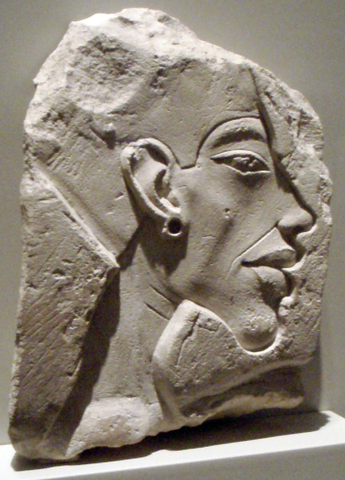
Relief portrait of Akhenaten (c. 1345 BCE): Akhenaten represented in the typical Amarna period style.
While the religious changes of the Amarna catamenia were brief, the styles introduced to sculpture had a lasting influence on Egyptian culture .
Painting of the New Kingdom
Painting for much of the New Kingdom connected to follow established conventions. However, pregnant changes to the homo form emerged during the Amarna Period.
Learning Objectives
Discuss Egyptian painting in the New Kingdom
Primal Takeaways
Fundamental Points
- For much of the New Kingdom, paintings continued in the conventions established during the Early on Dynastic Flow .
- Paintings in tombs connected to be made with the intent of making a pleasant afterlife for the deceased.
- During the Amarna Menses, human figures were produced in a more naturalistic and less idealized manner than figures from before eras.
- The decoration of Amarna Flow tombs for non-royals was quite dissimilar from previous eras and conspicuously worshiped the Aten over other gods and goddesses.
Key Terms
- Aten:
The supreme dominicus disk that assumed the noon of the Egyptian pantheon under Akhenaten'south religious reforms.
Painters for much of the New Kingdom continued to describe the homo figure in largely the same manner as their predecessors in previous eras. A meaning change, yet, occurred during the Amarna Period under the pharaoh Akhenaten (r. 1351–1334 BCE), when the body assumed a less idealized form . While many theories be as to why this modify occurred, the exact reason remains unknown.
TT52
The tomb known equally TT52 houses an official named Nakht and his wife Tawy (14th century BCE). Among the decorations are richly colored paintings that depict the couple in the standard xviii fists-high profile pose, frontal torso, outward palms pose. As in paintings of previous eras, both figures are the same height. Their skin tones also follow the traditions that depict men with night dark-brown skin and women with light xanthous skin.

Nakht and Tawy making an offering: The figures in this painting go on the conventions established during the Early Dynastic Period.
Elsewhere in the tomb, Nakht assumes a more dynamic (admitting even so stylized) pose equally he hunts and fishes, a convention that also follows the style established during the Early Dynastic Period.

Nakht hunting and fishing in the afterlife: The figures in these paintings convey a sense of dynamism, albeit however stylized as in the past.
During the New Kingdom, religious scenes comprise the majority of paintings in the tombs of the elite. This trend, echoed in the decorative objects in these tombs, is evident in the painting of Nakht and Tawy making an offering . However, scenes from everyday life, such as hunting and fishing, remain an important part of the imagery .
Amarna-Style Painting
Fine art from this period is characterized by a sense of increased movement and activity in images, with decorated and crowded scenes and many of the figures overlapping. Male and female figures are depicted with the aforementioned dark brown skin tone, a departure from the past in which women are depicted with lighter skin tones. The human body is portrayed more realistically, rather than idealistically, though at times depictions border on extravaganza. For instance, many depictions of Akhenaten'south body show him with broad hips, a drooping breadbasket, thick lips, and thin arms and legs. This is a divergence from the earlier Egyptian art which shows men with perfectly chiseled bodies, and there is generally a more "feminine" quality in male person figures. Some scholars propose that the presentation of the homo body as imperfect during the Amarna menses is in deference to the Aten.

Akhenaten'due south daughters: Post-obit the conventions of the Amarna Period, the figures in this painting have protruding bellies, overlap one another, and announced more relaxed than figures in previous eras. Although the depicted figures are girls, their skin tone is the same as their male counterparts.
Not-Aristocracy Tombs
Although many non-aristocracy tombs from the New Kingdom were plundered, leaving few images and objects for mod scholars to study, it is axiomatic that the ornament was quite different from previous eras. These tombs did non feature any funerary or agronomical scenes. Images of the tomb occupant were besides absent, with the exception of instances in which he or she was depicted with a member of the royal family. Decorations from the Amarna Flow clearly worshiped the Aten, with excerpts from the Hymn to the Aten often present in the tombs. There is an absenteeism of other gods and goddesses and no mention of Osiris or the underworld.
Source: https://courses.lumenlearning.com/boundless-arthistory/chapter/the-new-kingdom/
0 Response to "Egyptian Artwith the Exception of the Amarna Periodcan Be Described as Which of the Following?"
Post a Comment